A Legacy We Inherited. A Future We’re Building
Prison Education at Bedford Hills and Taconic
by Heidi Happonen
When Aileen Baumgartner talks about the day one of her literature students at Bedford Hills translated Spenser’s The Faerie Queene into rap and taught it to everyone on her unit, she still sounds a little amazed by it. “Everybody was learning the Faerie Queene,” Baumgartner said. “It was so good.”
That kind of moment, unexpected, electric, entirely earned, is what has kept Baumgartner at Bedford Hills Correctional Facility for nearly 25 years, and it’s the spirit Northeastern’s College of Professional Studies inherited this year when the University’s acquisition of Marymount Manhattan College brought two long-running prison education programs, at Bedford Hills and nearby Taconic Correctional Facility, into the CPS family.

A program that refused to die
In 1994, Congress voted to strip Pell Grant eligibility from every incarcerated student in the country, and prison education programs nationwide, including the one that had run at Bedford Hills for years, folded almost overnight. The program that exists today traces back to spring 1997, when a consortium of colleges relaunched it under an independent nonprofit, the same structure Taconic’s program still uses today. That nonprofit dissolved around 2002. Rather than let the program go, the professors involved formed their own nonprofit, working without pay and teaching themselves to fundraise while they kept doing what they do best: teach and inspire.

It worked, barely. Grants and individual donors kept it alive until Marymount’s president at the time, recognizing that the program’s commitment to social justice matched the college’s own mission, brought it in-house as a second campus in 2004. Baumgartner, who had come to Bedford Hills as a volunteer literature instructor in 2001, became a Marymount employee and has run the program ever since.
What began in 1997 with 39 students and three classes now serves more than 150 students each semester, between a quarter and a third of the facility’s general population, and has awarded more than 350 degrees to women who earned them from inside a maximum-security prison. Admission is open to anyone with a GED or high school diploma. Students who need it get tutoring until they’re ready for credit-bearing coursework. And they are hungry to learn: the completion rate for the program’s earlier master’s cohort ran near 70 percent, well above the national average of 61 percent for master’s programs, according to a federal-data analysis by the National Association of Student Financial Aid Administrators.
Across the street, at Taconic Correctional Facility, Kimberly Malone directs a parallel program. Her own path to this work wound through drug-recovery counseling, a homeless shelter, a decade running service programs for recent college graduates, and (almost by chance) a bus ride in Manhattan.
“I was reading a book about incarceration, and I got lost because I was new to New York City,” Malone said. “A few stops away from where I was supposed to get off was Rikers Island. I was like, oh my gosh, this is in my backyard.” She began volunteering there in 2015, later taught at a men’s facility through the nonprofit Rising Hope, and eventually left her day job to run a college program full-time through Hudson Link, the organization Taconic’s program partners with today for transitional and re-entry housing services.
Running a college where none was designed to exist
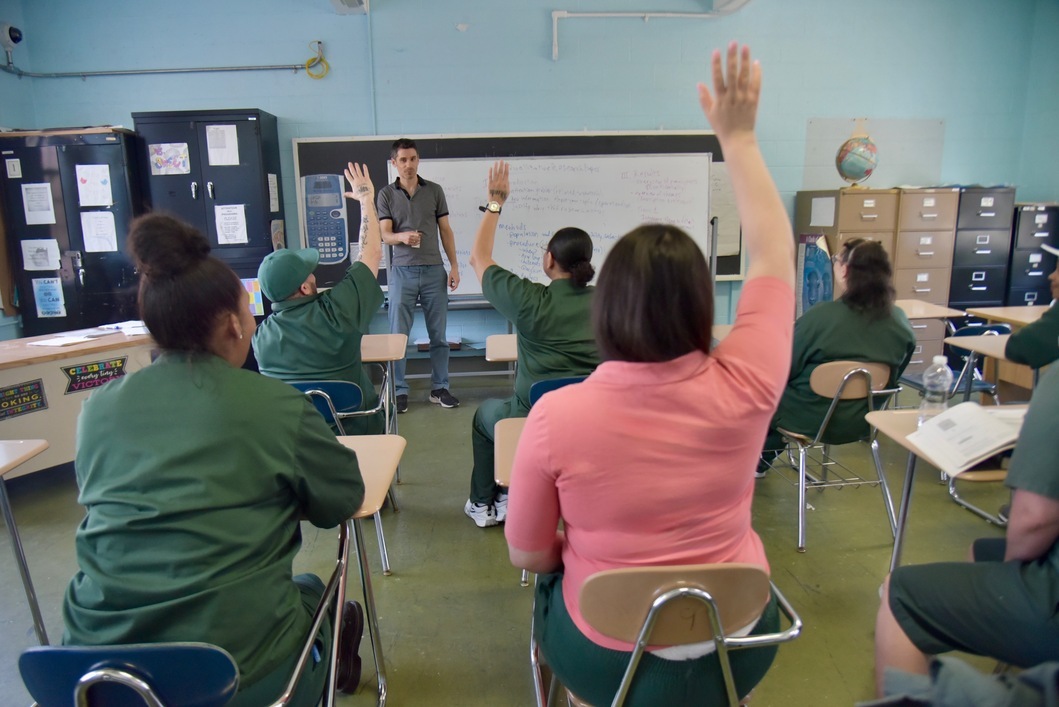
Both women describe their work in similar terms: improvisational, relentless, and quietly miraculous. “Prisons were not designed to run colleges, and colleges were not designed to run in prisons,” Malone said. “It is a minor miracle every day that we can have a semester run.” Faculty need clearance from both the college and the Department of Corrections and Community Supervision (DOCCS). Because students have no internet access, they rely on printed textbooks, often old, worn editions, that must be DOCCS-approved before they can come inside. Both facilities source notebooks, pens, paper, and art supplies for students who have none.
At Bedford, the barriers look a little different but land the same way. Students train on 24 networked computers in a library and learning center that has no internet access, but they’ve used those machines for Microsoft Office certification, web design, animation, and even a podcasting class. “There are roadblocks, certainly there are roadblocks,” Baumgartner said, “but they do get access to technology tools to help advance those skills.” Students have built resumes and LinkedIn-style profiles on the internal system, preparing for a job search they can’t yet begin.
“Prisons were not designed to run colleges, and colleges were not designed to run in prisons. It’s a minor miracle every day that we can have a semester run.”
Kimberly Malone, Taconic Correctional Facility

Despite (or maybe because of) those constraints, both programs have built something close to a full academic experience. Bedford students stage full theatrical productions (one took nine months of rehearsal to bring to the stage) and both locations have mounted joint art exhibits with outside artists, complete with an opening gala. Bedford has also hosted “combined” or inside-out classes with partner institutions, including Sarah Lawrence, Barnard, Fordham, SUNY Purchase, and Union Theological Seminary. In these classes, students from inside and outside the facility take the same course together, and something happens that no one designed for: the wall between them stops mattering. In class, everyone is just a college student.
What graduation looks like
Every year, both facilities hold a full commencement ceremony inside of the correctional facility where families are invited to attend. At Bedford, the ceremony takes place inside the facility’s gymnasium. The ceremony honors GED graduates alongside associate’s and bachelor’s degree recipients – roughly 20 to 25 graduates most years with more than 200 people in attendance. Students design their own table displays for visiting families, using little more than tissue paper and imagination. Baumgartner helps prepare commencement remarks and materials. For years, a professional photographer donated his time each spring; today Angela James, who succeeded him, now travels the state photographing prison graduations.
For a woman who has spent years reduced to a single mistake, walking across that stage in a cap and gown is nothing short of a reclamation.
Because families can’t bring in cameras into either facility, both programs hold a photo shoot a few weeks before the ceremonies so that they can provide prints for the families the day of the commencement, so each family can take home studio portraits of their graduate in cap and gown. “I had a student last semester who put the cap on her head and immediately started tearing up, because she’s like, ‘oh wow, this feels different. This feels like an accomplishment,'” Malone said.

And it is an accomplishment. For a woman who has spent years reduced to a single mistake, walking across that stage in a cap and gown is nothing short of a reclamation.
Why this matters to CPS
For CPS, this work feels less like a coincidence and more like a homecoming. Northeastern’s College of Professional Studies began over 150 years ago in the basement of a YMCA on Huntington Avenue in Boston, built to serve people who needed a path to a degree while they managed the rest of their lives. That same mission of access, flexibility, and a second (or third) chance, now extends into two correctional facilities in Westchester County, where nearly 200 students are working toward the same degrees, under the same university name, as students anywhere else in the CPS system at campuses across the US and Canada.
“In a lot of ways, this partnership doesn’t feel new to us. It feels like the latest version of who we’ve always been.”
Erin Clair, Associate Dean of Undergraduate Programs
The stakes reach well beyond any one classroom. A landmark RAND Corporation meta-analysis, commissioned by the U.S. Department of Justice, found that incarcerated people who take part in education programs are 43 percent less likely to end up back in prison than those who do not, and that every dollar spent on prison education saves an estimated four to five dollars in future incarceration costs. Inside Bedford Hills and Taconic, those numbers stop being numbers. They have names, faces, and diplomas.
“CPS began as a college for people who didn’t fit the mold of traditional higher education for people who needed a different kind of access to get their degree,” said Associate Dean of Undergraduate Programs Erin Clair. “That’s exactly what’s happening at Bedford Hills and Taconic. In a lot of ways, this partnership doesn’t feel new to us. It feels like the latest version of who we’ve always been.”
What comes next
Both Baumgartner and Malone express cautious optimism about what a larger university can offer that a small nonprofit, or even a small college, could not. “We have the potential to put eyes and ears and heads together… to support these students in new ways that we weren’t able to before,” Malone said. Already, small signs of that partnership are visible: Northeastern gear finding its way onto prison classroom walls, conversations underway about Dean’s List recognition for incarcerated students, something Baumgartner says matters enormously, since a Dean’s List letter can be included in a student’s parole file, and plans taking shape for the college to support both facilities’ commencement ceremonies going forward.
Two of Taconic’s faculty members this semester are formerly incarcerated women and one is a graduate of the very program she now teaches in. It’s a detail Malone mentions almost in passing, but it captures what’s at stake in this partnership better than any statistic could: a program built by volunteers who refused to let it die in 2002 is still, more than two decades later, producing the people who will carry it forward.
Thirty years ago, Congress may have closed the door on students like these. But Bedford Hills and Taconic never waited for permission to matter. They kept teaching anyway, one class at a time, in a classroom with chalkboards and desks, and, once, a rap version of an Elizabethan epic poem. CPS did not just inherit a program. It inherited a promise, made by a handful of professors who worked for free rather than let it die, and it is a promise this college now intends to keep.