CHEW joins global peers at the Future Universities Alliance Summit at Duke
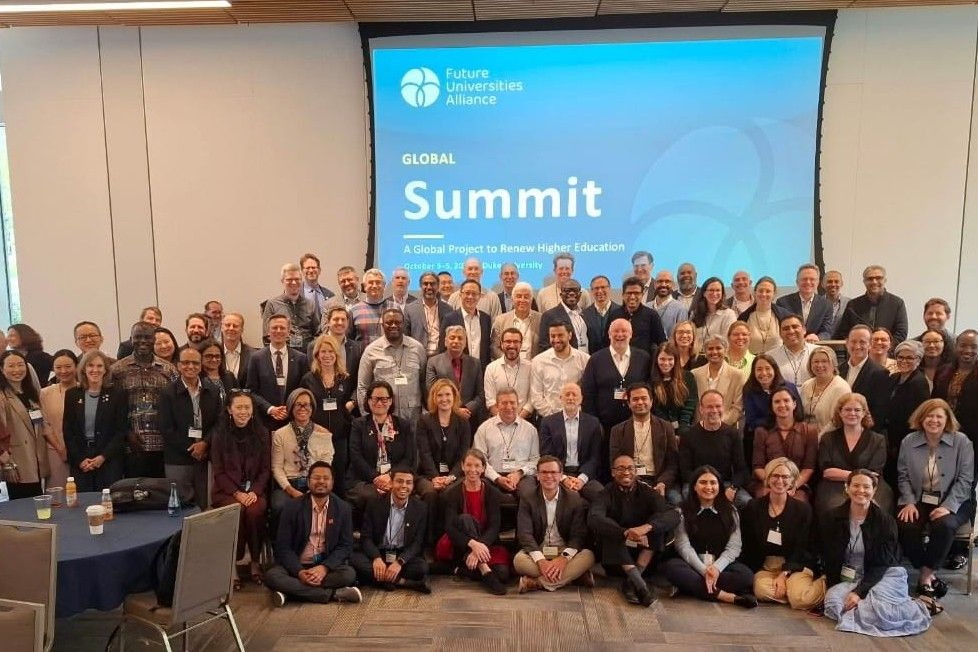
Leaders from Northeastern’s Center for the Future of Higher Education and Work (CHEW) went to Duke University October 3–5 for the Future Universities Alliance Global Summit. They joined teams from 49 institutions in 23 countries and on five continents to work on how higher education can renew itself.
Duke convenes the Alliance. Its members are a deliberate mix of startups, new and growing universities, and long-established institutions. Through the Alliance’s Innovation Sandbox, each member brings a live project backed by its senior leadership. Teams work in small cross-national “pods” that meet monthly, and the summit is the cohort’s in-person gathering.
Northeastern takes part in two ways. CHEW Senior Director Sasha Goldman leads Northeastern’s Sandbox project with Jared Auclair as is its executive sponsor. CHEW Executive Director Connie Yowell is one of the Alliance’s seven Sandbox facilitators. She guides pods focused on entrepreneurship and community innovation, and on access, student success and workforce pathways.
Northeastern’s project tests how a university can act as a trusted intermediary for non-degree, industry-aligned credentials. Northeastern doesn’t provide the training. Its role is to set quality standards, map training to career and education pathways, and build the data infrastructure that lets credentials travel with learners. The first proof of concept is in shipbuilding. With General Dynamics Electric Boat, the team is piloting a stackable welding badge built on a Navy-standardized curriculum shared across U.S. shipyards. Learners keep the badge in their own digital wallets and can carry it into employer hiring systems and on into further education. The team expects a working proof of concept by the end of 2026 and is considering healthcare and life sciences as the next sector.
Northeastern sits in Pod 4, “Leadership, Talent and Employability Systems,” with Alwin Education (South Africa), inVision U (Kazakhstan) and Botho University (Botswana). The four institutions span three continents and very different models. They share one question: how to build, and get employers to recognize, the durable skills students need for work.
At Duke, the discussion kept coming back to that question. Across the concurrent sessions, stackable and work-connected credentials came up at nearly every table. So did the problem no one has solved yet: how to give credit for learning that happens across settings, how to assess it, and how to transfer it. Other sessions covered unbundling faculty roles, the value of practitioner faculty (a long-standing strength of the College of Professional Studies) and the human cost of sustaining innovation inside institutions.
The Alliance’s first cohort continues through the coming year. Learn more about the Future Universities Alliance.