The Invisible Hand: Why Project Management Might Be the Most Portable Career You’ve Never Considered

Two CPS faculty leaders on how Northeastern’s undergraduate and graduate project management programs prepare students to turn ideas into reality, in any industry.
By Heidi Happonen
Here’s a confession: I’m not a project manager. At least, I didn’t think I was until about twenty minutes into my conversation with Kerri-Ann Williams and Ogechi Onyechere.
I recently had the opportunity to sit down with Williams, Program Director of the Master of Science in Project Management (MSPM), and Onyechere, Academic Lead for the Bachelor of Science in Project Management degree. I came away understanding why so many people end up in project management without planning to, and why they stay.
Nobody grows up wanting to be a project manager
Williams put it bluntly: no child says they want to grow up to be a project manager. Neither of them did.
Onyechere applied to study mathematics and computer science at the Federal University of Technology, Owerri in Imo State, Nigeria, only to learn at enrollment that she’d been placed in project management instead. “I cried my eyes out because I did not know what that was,” she told me. She planned to transfer, until a Project Management Institute (PMI) representative visited campus in her first month. “I was like, wait, what? This is making sense.” She never transferred.
Williams started in biotechnology, then joined the army, where she managed projects without calling it that. Project-centered industry roles, a Project Management Professional (PMP) certification, and a doctorate focused on project management followed. “That’s how I kind of tripped into it,” she said.
So what does a project manager actually do?
Onyechere explained the job through everyday objects: a phone starts as an idea, and someone has to assemble the right people and guide them to a finished product. The same goes for glasses, houses, even COVID-19 vaccines.
Williams framed it in similar terms: “It’s a matter of taking high-level abstract strategies, ideas, and desires and actually translating that into reality.” The project manager is the bridge, coordinating resources so the outcome arrives on time, within constraints, and as intended.
She added another layer of nuance to her definition. “As a project manager, I’m the invisible hand in the background, moving the pieces into place,” she said. “You don’t notice it. You see the finished product.”
As someone in marketing and communications who has produced more than her fair share of events, I know this well. I often compare it to the holder on a football field goal: nobody notices you unless something goes wrong.
As a project manager, I’m the invisible hand in the background, moving the pieces into place. You don’t notice it. You see the finished product.
Kerri-Ann Williams
Not an industry but a discipline
Early in our conversation I called project management an industry, and they both corrected me. “I don’t call it an industry. I call it a discipline,” Williams said. “It permeates all industries.”
Organizations run on projects, Williams explained, so demand is strong everywhere. Both pointed to healthcare as the field shifting most, driven by AI-enabled diagnostics, research, and medical manufacturing. PMI research now ranks healthcare as the most complex industry for projects, Onyechere noted, ahead of manufacturing and aerospace.
What AI can’t do
People considering the field often ask whether AI will take these jobs. Technology has absorbed much of the “drudgery,” as Williams calls it, from tracking to meeting minutes. But neither thinks the core of the job is going anywhere.
“The core essence of project management,” Williams said, “is the management of people.” Onyechere described communication as about 90% of the work, from reading body language to noticing who goes quiet. “How is AI going to do that?” she asked.
Two programs, one philosophy
The MSPM generally serves students with work experience who want to advance. Williams said it emphasizes real-world application, communication, and leading projects under uncertainty, with a focus on delivering measurable value well after a project ends.
The undergraduate program, Onyechere explained, serves many working adults, including veterans and parents returning to school. It covers what happens before a project even begins. “Why are we even starting a project, for goodness sake?” she said. Students learn business needs, gap analysis, and business cases, so they see that every project connects to an organizational goal.
The result, Williams said, is that graduates “don’t leave simply as project managers.” They leave with the potential to become business leaders, because they understand the difference between “project success and project management success.” A project delivered on time and on budget, in other words, isn’t necessarily one that delivered value.
Both programs are accredited by PMI’s Global Accreditation Center, yet neither faculty member sees the degree as PMP prep. Even students who arrive with a PMP encounter new material.
Learning by doing, and by being put on the spot
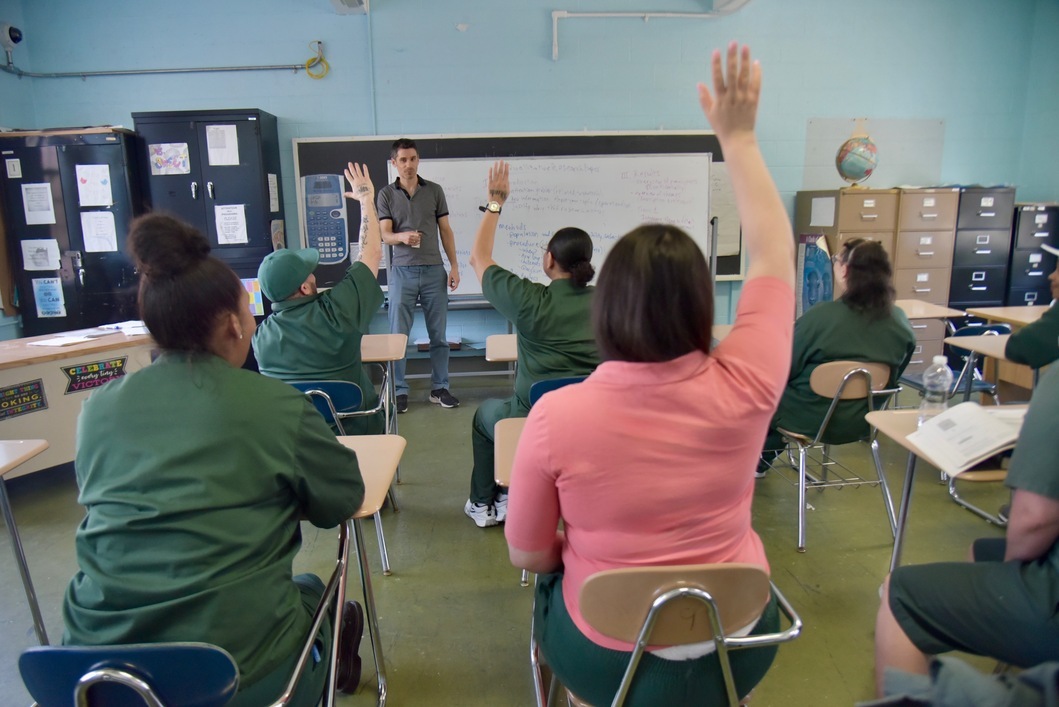
Experiential learning runs through both programs. In Williams’ cost and scope course, students price out a real over-budget project from the news and analyze where it went wrong. Students also consult with industry partners and build capstone plans for real organizations, and most MSPM students complete a co-op.
During group presentations, both faculty members ask students to explain a slide someone else wrote. “If you don’t understand the whole project, you’re not managing the project,” Williams tells them.
Students don’t always like it. Williams recalled one introverted student who was upset at first. By graduation, the two had “mended fences,” and the student has since been promoted several times by taking on stretch projects.
The faculty practice what they teach. Every instructor brings at least ten years of industry experience. “If you have not done the work yourself, you cannot teach here,” Williams said.
Where it can take you
Many graduates use their training in roles without “project manager” in the title. One of Onyechere’s former master’s students is now a change leadership specialist at a major Boston-area hospital, helping C-suite leaders shape early ideas into initiatives, and is considering a doctorate.
Why now?
I asked what they would tell someone weighing a bachelor’s or master’s in the field.
“If you want to keep your options open, project management is an excellent discipline to pursue because it’s industry agnostic,” Williams said. “You’re not locked in a box.”
Onyechere called it “plug and play.” When she applied for a role in medical manufacturing, the posting asked for an engineer, but the hiring manager mainly wanted to know whether she understood project management. Williams once led a team of neuroscientists and brain health physicians. “I had no idea what they were doing,” she said. “I managed the project. Got it done.”
That may be the best case for these programs. The specific industry can change. The ability to turn ideas into results applies everywhere.
Learn more about Northeastern’s Bachelor of Science in Project Management and Master of Science in Project Management.