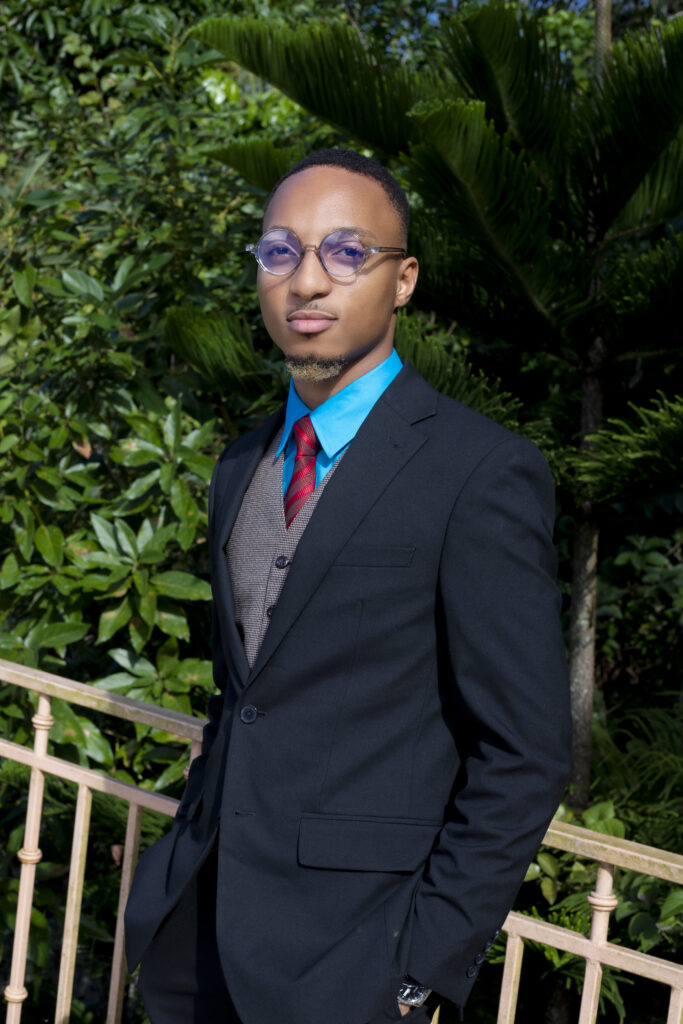
Loyd Joseph
Bachelor of Science in Project Management
Where are you from or where do you consider home?
Port-au-Prince, Haiti
Three words to describe your experience at Northeastern:
Ask. Seek. Knock.
What motivated you to continue through challenging times in obtaining your degree?
The belief I wrote in my personal statement when I applied to CPS is the same belief that carried me through every hard stretch of this degree. I am convinced that enhancing the agricultural and industrial sectors is the key to building a future where Haitian youth are provided with opportunities to fully develop their potential. My project management degree and engineering background hold the key to contributing to that vision. That conviction never wavered.
Whenever things got overwhelming, I went back to a morning I have carried since I was six years old. My dad was driving me to school in Haiti. At an intersection, I watched a boy my exact age wiping car windows in the heat for spare change. I remember asking myself: why is my life different from his? That question never went away. It just got heavier. When I left Port-au-Prince to study in the United States, I knew exactly what I was leaving behind. People. Possibilities. A country that deserved better.
There were semesters when I was not sure I would make it through. Nights where a rejected pitch made the whole vision feel out of reach. In those moments, I went back to that intersection. I thought about the people waiting on the other side of this degree. Going home empty-handed, with only good intentions to show for it, has never been an option I was willing to accept. My degree and TwoCents are not about personal wealth. They are about building the resources and credibility to do something real and lasting with a privilege I did not earn.
My faith has held me through more than I can fully explain. I have prayed, genuinely, asking why God continues to favor me this much. The answer I keep coming back to is responsibility. That is what kept me going through every burnout, every failed pitch, and every sleepless night. Knowing that every day I do not push forward is another day I am delaying my ability to make a sustainable impact for my people.

What has your journey revealed to you about yourself?
My journey at Northeastern revealed to me that it is okay to want to be great. It is okay to want to do great things, and it is okay to want more than what you have had before. And it is fully okay to go for it and to keep going until you reach it.
This place taught me that vision is everything. Not the kind that depends on what you can currently see in front of you, but the kind that comes from the heart — the kind Dr. Myles Munroe described when he said: “the greatest enemy of your vision is your eyes, because sight restricts you to the present.” That stayed with me. I stopped letting what I could see limit what I believed I could build.
When I transferred into Northeastern and switched my major to Project Management, I lost a significant number of college credits. I thought I was setting myself back by two to four years. Instead, the most extraordinary directional shift of my life happened right there. Northeastern gave me the time and the environment to develop into who I was always meant to be. Now that I am leaving, I wish I had more time here.
But I am leaving with something I cannot put a price on: self-efficacy and self-agency. The deep knowing that I can be everything, do everything, and have everything my vision can see. That is what Northeastern gave me.
Experiential learning is a core component of a Northeastern education. Describe some of the highlights for you.
The clearest sign that Northeastern’s model worked for me is that most of my best learning happened before I recognized it as learning.
My co-op at The Food Project in Boston was, honestly, everything. I led workshops for high school students through their Seed Crew summer program, an age group I had never worked with professionally before. My manager noted that engagement went noticeably higher during my sessions, and students said the workshops felt different from school. That told me something about how I communicate and connect, and I carried that forward.
But the most important thing that came out of The Food Project was something I discovered away from the workshops. I was getting my first regular paychecks in a while. One morning I looked at my account and realized I had spent a thousand dollars in a single week without noticing. I had been tapping everywhere, completely unaware of where my money was going. It shook me. When I joined my New Venture Creation class at Northeastern and needed a project, I kept coming back to that moment. That was the problem I understood firsthand. That experience is what kick-started TwoCents.
From there, everything accelerated. I went through the Husky Startup Challenge for the fourth time and made it to Demo Day. Started crafting it as my third startup concept within IDEA, Northeastern’s venture accelerator. When my CTO stepped down, I taught myself AI-assisted development to keep building after Northeastern released Claude for free to its student body. Each of those moments was experiential learning in the truest sense — the kind that does not feel like school until you look back and realize how much it shaped you.
Serving as President of Haitian Student Unity was its own classroom. I organized the first Massachusetts Haitian Student Unity Forum, bringing together student leaders from Harvard, Northeastern, UMass, Boston College, and other schools. No budget, no template, no guarantee anyone would show up. They did. Leading that event and holding together a coalition across multiple institutions taught me more about real leadership than any case study I read in class.
Where do you imagine yourself five years from now?
Five years from now, TwoCents is a proven platform, and the people using it are not just Gen Z broadly. They are first-generation Americans. Immigrant families. People for whom money has always carried anxiety instead of agency. I will have shown that financial wellness works when it is built for the people who need it most, not the people who already have it figured out.
Beyond that, I am building economic bridges. Billions of dollars flow between the Haitian diaspora and Haiti every year. Most of it gets absorbed without constructing anything lasting. Five years from now, I am actively working to change that. The tools, the relationships, and the credibility I am building here are all pointed in that direction. Where I come from is not a footnote to this story. It is the whole point.
This place taught me that vision is everything. Not the kind that depends on what you can currently see in front of you, but the kind that comes from the heart — the kind Dr. Myles Munroe described when he said: “the greatest enemy of your vision is your eyes, because sight restricts you to the present.” That stayed with me. I stopped letting what I could see limit what I believed I could build.
Loyd Joseph
Is there anything else you wanted to say that we didn’t cover?
This journey was not clean. Before TwoCents made it to Demo Day, I had failed on four previous startup attempts. The first one never shipped. Not because the idea was bad, but because I had passion and almost no execution discipline to go with it. That gap cost me real time and taught me more than any success would have.
People on campus probably know me as the guy who shows up to pitch events in brightly colored outfits that match his slide deck. That is real, and I am not apologizing for it. But behind that, there was a lot of quiet, grinding work. Learning how to actually lead. How to hold a team together when things fall apart. How to know when to be the loudest person in the room and when to sit down and listen. That transition — from someone with enormous potential to someone who actually ships things — is the real story of my time here.
None of this was mine alone. My ancestors left us a proverb: “L’union fait la force.” Unity makes strength. My co-founders, my HSU e-board, my professors, and the mentors who checked my blind spots when I could not see them — I carry all of them with me. I am a product of every person who chose to invest in this community and in me.
If I leave anything here, it is this: the willingness to ask, even when the answer might be no, is everything. It is where all of it started. It is what I will never stop doing.
Connect with Loyd on LinkedIn.