Two CPS EdD Graduates Named Fulbright Specialists
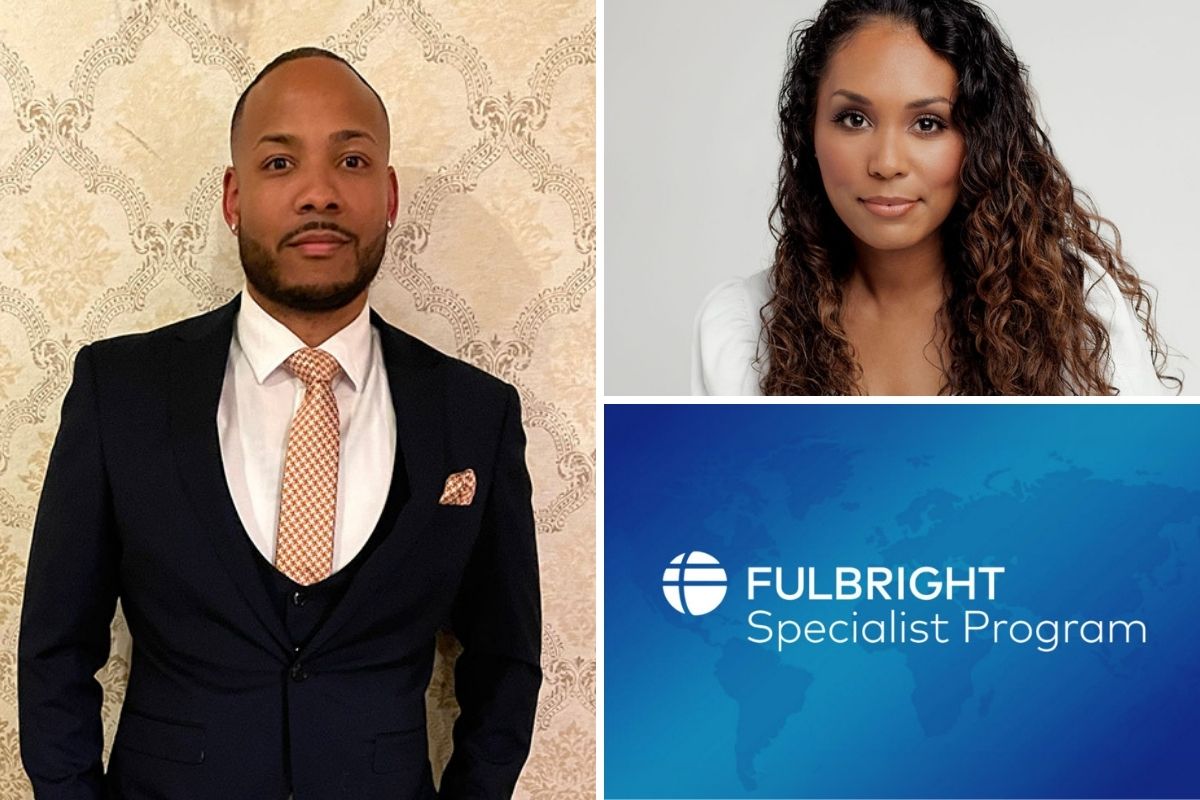
Dr. Holly Davis and Dr. Baron Dyer are taking their doctoral research to the global stage — carrying work that began inside Northeastern’s College of Professional Studies into institutions and communities around the world.
The Fulbright Specialist Program doesn’t accept many people. Administered by the U.S. Department of State, it places credentialed experts at institutions in more than 150 countries to collaborate on some of the world’s most pressing educational and social challenges. Specialists are selected through a rigorous peer-review process and join a roster of globally recognized practitioners who are called upon to consult, teach, and solve complex problems that cross borders.
This year, two graduates of Northeastern’s College of Professional Studies Doctor of Education program earned that distinction. Dr. Holly Davis completed her EdD in 2025 with a focus on workplace learning and the retention of Black women in organizational leadership. Dr. Baron Dyer earned his EdD in 2024 researching how police officers experience the communities they serve, and how immersive engagement can transform those experiences for the better.
Both came into the program as working professionals with real problems they wanted to solve. Both left with research that was immediately applicable. And both are now carrying that work into a global conversation about how institutions can do better by the people they serve.
DR. HOLLY DAVIS — EMPOWERING LEADERSHIP
Holly Davis spent more than twelve years as an HR practitioner navigating corporate environments where she was often one of the only Black women in the room. She came into Northeastern’s EdD program with a workplace learning concentration and a specific, urgent question: why do Black women in leadership keep leaving? And what can organizations actually do about it?
Her dissertation, completed in February 2025, used an action research design across two cycles. In the first, she conducted in-depth interviews with ten Black women in senior leadership roles across finance, healthcare, technology, education, nonprofit, consulting, manufacturing, government, law, and retail. Three themes emerged consistently: a lack of support and accountability from organizational leadership, unique barriers arising from the intersection of race and gender, and the absence of visible representation in senior roles. Eighty percent of participants reported that leadership in their organizations had not taken accountability for the lack of resources to support Black women leaders.
“Despite our ambition and readiness to lead, leadership opportunities are often inaccessible because organizational leaders fail to take responsibility for addressing systemic barriers.”
Cycle 1 Participant
In her second cycle, Davis designed and facilitated the Peer Leadership Collaborative consisting of a six-week series of one-hour structured sessions for ten newly recruited Black women leaders. Each session addressed a topic drawn directly from the Cycle 1 findings: navigating microaggressions, building professional networks, self-advocacy and negotiation, leadership development, representation and visibility, and overcoming systemic barriers. Guest speakers, role-playing exercises, and open peer discussion were woven throughout.
The results were measurable. By the program’s end, 80% of participants reported increased confidence in self-advocacy, up from 40% at the start. Professional network strength increased 35 percentage points. Confidence in navigating workplace challenges rose from 35% to 75%. Participants co-created practical toolkits, including guides on self-promotion, mentorship frameworks, and bias response strategies, that many began implementing in their own organizations before the program even concluded.
Davis credits the EdD program’s emphasis on action research and stakeholder engagement as direct preparation for the Fulbright application process, which asks specialists to articulate how their research can be applied in new global contexts. She brings to the program not only her doctoral findings but her professional background at Citibank, where she collaborated daily with colleagues across Europe, Asia-Pacific, and beyond.
“Whether your concentration is workplace learning, leadership, or higher ed — you’ll find your niche. The program prepares you to think not just within your own organization, but in a global context.”
Holly Davis
Davis is now on the Fulbright Specialist roster, reviewing placements in Japan, Egypt, and South America, and is waiting for the right fit. She’s drawn to engagements where her expertise in organizational change, DEI strategy, and peer-based leadership development can cross into new cultural terrain. And she’s confident that the problems she finds on the other side of the world may not be all that different from the ones she’s been studying here.
DR. BARON DYER — PERCEPTIONS AND REALITIES IN POLICING
Baron Dyer has spent over thirteen years in law enforcement and currently serves as a Sergeant. He also grew up in a single parent household and has seen both sides of the divide between police and the communities they patrol.
“I see why police officers think the way they think. But I also see why people in the community don’t like the police.”
Baron Dyer
That dual perspective became the engine of his EdD research, which he completed in March 2024. Dyer’s dissertation used action research to examine what was driving negative experiences for police officers policing a BIPOC community in a mid-sized northeastern city, and then to design, implement, and evaluate an initiative to change them.
In Cycle 1, he conducted individual semi-structured interviews with ten officers ranging from patrol to senior supervisors. Six themes emerged, including unfavorable views of the downtown community, a perception of general discontentment from residents during police encounters, and the belief that media and family narratives shaped community attitudes toward police before any individual interaction ever occurred. Critically, participants also identified something more constructive: a genuine desire for more personal engagement with community members, outside of the context of calls for service and investigations.
“Do we really know who the people are that we’re serving? They’re our neighbors. We’re in the city forty hours a week.”
Cycle 1 Participant
Cycle 2 translated those insights into action. Dyer designed an initiative he called a preparation for organizational readiness for community engagement, approved and supported by the Chief of Police. From mid-March to mid-July 2023, twelve officers participated in weekly Friday and Saturday engagement tours where two officers at a time, in uniform, were intentionally present in the downtown area from 4 to 8 p.m. using conversation-starting “ice breaker” questions to meet residents in convenience stores and the local shopping plaza outside of their enforcement role. A monthly community clean-up, conducted in plain clothes, added a second dimension to the work.
The results were not uniform, and Dyer is careful to say so. Officers who completed three or more tours reported transformative shifts in how they understood the community, seeing it as family-oriented and hardworking rather than defined by crime. Those who completed only one or two tours had transactional rather than transformative experiences. The threshold for sustained perception change appeared to require repeated, immersive exposure. Several participants noted that residents who had initially been guarded became increasingly open and welcoming, and that shop owners began greeting them by name. One officer described playing basketball with children in the area. Another shared a meal with a resident outside their home.
“I feel changed by this experience and feel like I’m a better cop because I got to interact with the people here, seeing families with their children just living their everyday lives.”
Cycle 2 Participant
The initiative’s three core findings: that engagement fosters communication and understanding, that experiential learning aids community policing, and that immersive contact builds a sense of trust and belonging among officers — are now informing how Dyer applies his research in his own department, using the principles with new officers during their early weeks on the job.
For the Fulbright Specialist Program, Dyer is pursuing placements in India, a connection that is both professional and personal. His doctoral literature review drew heavily on Indian research as one of the few bodies of scholarship that examined police officers’ perceptions of their communities, as opposed to communities’ perceptions of police. On a personal note, his mother is from India, so this journey is also about exploring his own heritage. The Fulbright gives him a pathway to bring what he learned in a northeastern American city into police departments navigating strikingly similar challenges on the other side of the world.
“I wouldn’t have been able to become a Fulbright Specialist without the EdD program. The question my research answers isn’t just about policing — it’s about whether institutions can learn to see the people they serve. That’s a question that matters in every country and every system where power and community meet.”
Baron Dyer
A MODEL FOR WHAT’S POSSIBLE
What connects Davis and Dyer, beyond the Fulbright and beyond the degree, is a conviction that research isn’t meant to sit on a shelf. Both entered the program as practitioners with specific, lived problems. Both used action research’s iterative design to move from investigation to implementation to evaluation within the same study. And both are now being recognized, globally, for the rigor and relevance of what they produced.
For current and prospective students considering the CPS EdD, Davis offers a direct answer about what the program opens up:
“Whether your concentration is workplace learning or leadership or higher ed, you’ll find your niche that can be helpful. You’re prepared to think not just within your own organization, but really in a global context — how you can solve problems, communal problems.”
Holly Davis
Dr. Holly Davis (EdD ’25) and Dr. Baron Dyer (EdD ’24) are both graduates of the Northeastern University College of Professional Studies Doctor of Education program. Connect with them on LinkedIn: linkedin.com/in/drhollyadavis — linkedin.com/in/dr-baron-a-dyer-646a4a18b