What It Means to Be First: Inside Massachusetts’ Inaugural AI Apprenticeship
by Heidi Happonen
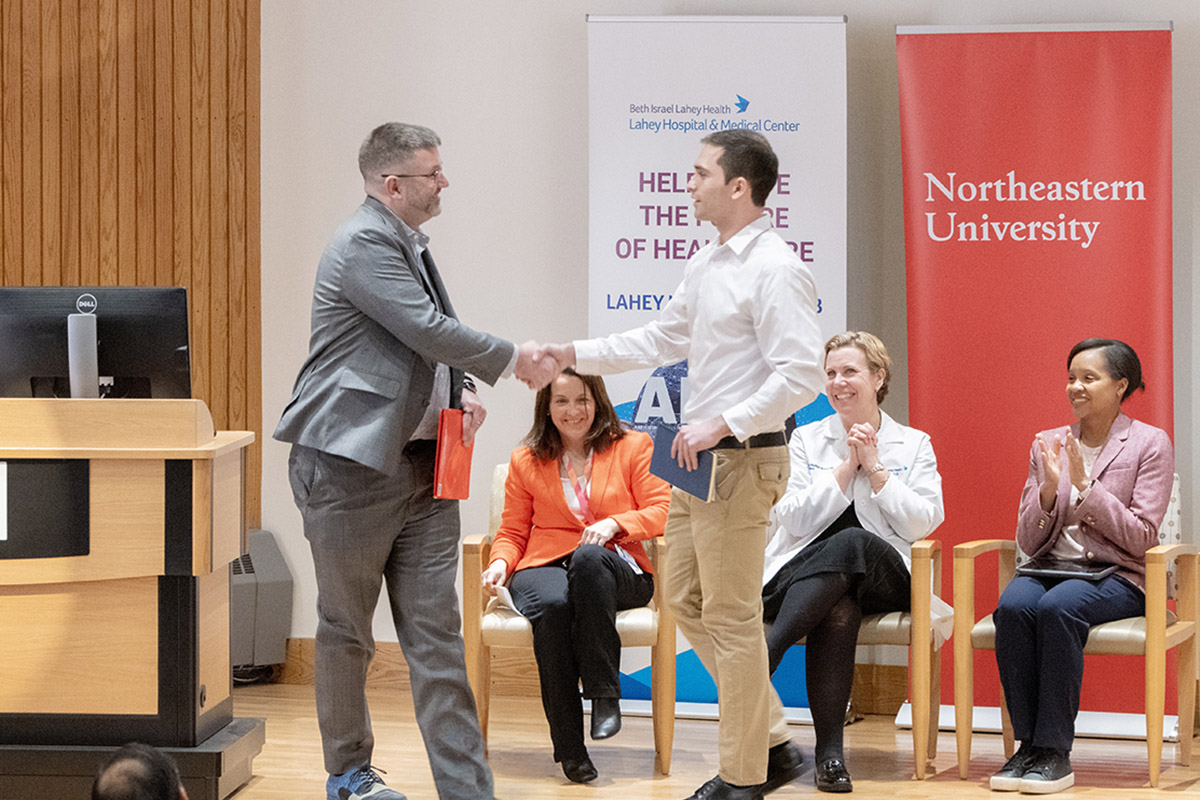
When Diego Martins walked into Lahey Clinic in Burlington, Massachusetts earlier this year, he carried something no one in the state had carried before: the title of AI healthcare apprentice.
The weight of that distinction wasn’t immediately obvious to him.
“My parents are proud of me,” Martins says with a smile. “My friends were pretty jealous. At least the ones in technical fields.”
The pride is warranted. Martins, a recent graduate of Northeastern University’s College of Professional Studies (CPS) analytics program and current graduate student in Applied AI, is the first registered AI apprentice in the Commonwealth of Massachusetts — a program also believed to be the first such AI apprenticeship in the country tethered to a four-year bachelor’s degree. For everyone involved, it’s not a milestone to mark and move on from. It’s a blueprint.
A Gold Standard, Expanded
Registered apprenticeship is not a new idea. The model has been central to building and construction trades for centuries: full-time, hands-on work under a mentor, supplemented by structured classroom instruction. What’s new, and significant, is who it’s for now.
“Healthcare is facing a workforce crisis. Like manufacturing, there are occupations where the same people have been doing the same roles for 40 years, and we need to tap into that expertise before it walks out the door,” says Pat Rae, an apprenticeship liaison with the Commonwealth’s Division of Apprentice Standards (DAS), the state agency that oversees and certifies registered apprenticeship programs.
DAS has been expanding beyond the trades for several years, moving into healthcare, education, and IT. The collaboration with Northeastern and Lahey represents the newest frontier: AI. And unlike previous higher education partnerships, which typically involved community colleges, this one is anchored to a four-year research university.
“Northeastern is the first four-year school to issue this type of program,” Rae notes.
The model’s appeal isn’t just its novelty. The data behind it is compelling: 95 percent of apprentices stay with their employers for up to five years. Federal and state figures show a $1.50 return for every dollar an employer invests. Massachusetts also offers a registered apprenticeship tax credit. This year, nearly $1 million is available for employers to reinvest.
“What makes this model truly valuable,” Rae says, “is that it is employer-driven. It is, ultimately, the gold standard.”
A Natural Fit at Lahey
For Richard Meiklejohn, who leads innovation efforts at Lahey Clinic, the apprenticeship program wasn’t a hard sell. It was a logical extension of something he already believed in.
“Northeastern has been a leader with their co-op model,” he says. “This felt like the natural extension of that. We look at all the pressures, not just within healthcare, but finding work, finding the right talent, nurturing that talent. This just felt like the right fit.”
Lahey’s culture, Meiklejohn argues, is unusually positioned to make this work. Where hospitals can default to risk-aversion, Lahey has cultivated a drive to lead. “People here want to do things differently. They want to be first.” That mindset also shapes how Meiklejohn thinks about the apprenticeship’s potential to scale. He envisions Diego as a proof of concept. One that, if successful, could grow into something much larger.
“We introduced Diego and said: we’ll clearly be teaching you, but we’ll learn from Diego as well,” Meiklejohn says. “Bringing that fresh perspective and creating value through the process is how this scales.”
What an AI Apprentice Actually Does
On any given day, Diego Martins might be helping oversee the rollout of a new medical transport device from a Canadian company, collecting and analyzing survey data from clinical teams, or building dashboards for department managers. Sometimes all three.
“It can vary wildly,” he says.
What’s surprised him most isn’t the technical complexity, though. It’s the breadth. Martins expected an analytics-heavy role. What he found was something richer: exposure to healthcare finance, technology evaluation, project facilitation, and the rhythms of a major health system.
“I work alongside my manager, who comes from a business background. I’ve been exposed to the financial side of how a company operates, what you evaluate when a new company comes in, what Lahey specifically wants out of a technology partnership. A lot of business dimensions I didn’t anticipate.”
That breadth has pushed Martins to draw on skills his data analytics degree didn’t explicitly teach: how to communicate with senior leadership, how to follow up, how to navigate an organization where getting something done requires knowing who to ask and how to ask them.
“You don’t really get that through being in a classroom,” he says. “Getting that experience through the apprenticeship has been very valuable.”
When he isn’t doing any of the above, Martins has been building. On his own initiative, he developed what he calls a “workflow studio tool” — an application that takes a team’s workflow, either as a PDF or plain text, and uses AI to generate a flowchart. The system then identifies bottlenecks and delivers a summary to the team manager.
“I went to a further extent than what was defined,” he says. “My advice to any organization considering an AI apprentice: let them roll. They will create things you didn’t even think of.”
You learn on the job while you’re still studying. You apply what you learn in the classroom at work, and you bring what you’re learning at work back into your studies. And that stands out to future employers.
Diego Martins
Where Academia Meets Industry
For Uwe Hohgrawe, Associate Dean of Global Learner Access, Strategic Partnerships, and AI at Northeastern’s College of Professional Studies, the program represents something the university has long worked toward — and something the moment now demands.
“The gap between academia and industry is being compressed and pressurized all the time,” Hohgrawe observes. “Through collaborations like this, you create avenues for value creation and for people to get the experience they need to go forward in their careers.”
The program sits at an intersection that feels increasingly urgent: AI is reshaping the job market at the same time that employers are struggling to find people who can deploy it thoughtfully. Martins sees this firsthand. “A lot of people know AI is here,” he says. “They just don’t understand it, or they think it’s hard when it’s really not. That awareness just isn’t out there yet.”
His own view of where he fits in that landscape has sharpened through the apprenticeship. Healthcare, he’s concluded, is a domain where the need for people who can work alongside AI, rather than be replaced by it, is both obvious and durable. “Being part of that rollout of automation in healthcare, I believe I’ll find security there.”
Martins is continuing his studies this fall in CPS’s Applied AI master’s program, working and learning simultaneously, exactly what the apprenticeship model was designed for. He has 2,000 hours to complete and eight months left on the clock.
“This concept should be pushed more,” he says simply. “You learn on the job while you’re still studying. You apply what you learn in the classroom at work, and you bring what you’re learning at work back into your studies. And that stands out to future employers.”
For Pat Rae, Diego Martins is exactly the story the model was built to tell. “It’s a tool for someone with zero experience on day one,” Rae says. “By the end of the program, they have the skills to be successful. We’ve heard that across industries: the employer takes a chance, and the apprentice is set up for success.”
The foundation, as Hohgrawe puts it, is built.
“We can continue on this path and build something competitive and meaningful for both students and industry.”
Diego Martins is a graduate of the analytics program at Northeastern University’s College of Professional Studies and a current student in the Applied AI master’s program. He is the first registered AI apprentice in the Commonwealth of Massachusetts, through a collaborative program between Northeastern, Lahey Clinic, and the Massachusetts Division of Apprentice Standards.